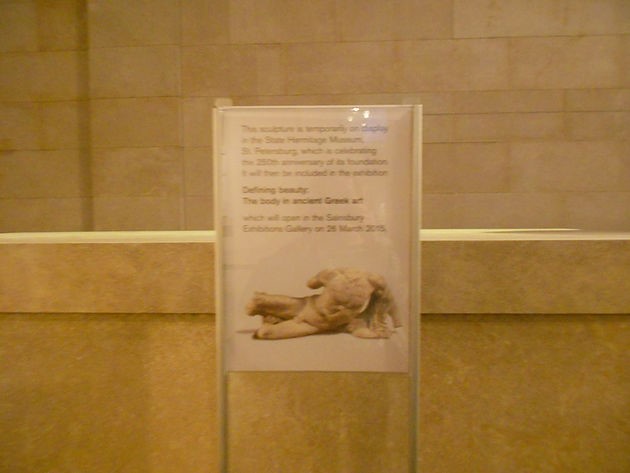
I was rather surprised to see that the figure of Ilissos from the West pediment of the Parthenon and a member of the famously disputed Elgin marbles, was transported to Russia for an exhibition at the Hermitage in St Petersburg.
In the world of museums, it is not unusual at all for pieces to go on loan to other institutions and is part of the important interchange of exhibits across the world. Indeed the British Museum has had an exhibition entitled ‘Body Beautiful’ with famous pieces like the Townley Discobolos on tour for almost 5 years, to be coming back to London this May.
So in theory there should be nothing unusual with this loan. But as part of the infamous Elgin Marbles, this move is therefore part of a much larger and hotly contested issue, not least for the fact that this is the first piece to ever have been moved since they were taken from the Parthenon in 1801-12.
I have always had mixed opinions on the Elgin marbles debate….of course as a Londoner myself, visiting the BM and seeing the amazing sculptures of the Parthenon inspired me to study the ancient world and they are indeed part of one of the best museums of the world that holds so many treasures. But really how much of the British Museum has anything actually British in it? Not much. I always felt that a return of the Elgin marbles would mean the return of all the objects from all the other countries as well and that would be a great shame for an amazing research institution with a high footfall every year that inspires plenty of people, young and old from around the world to discover more about past societies.
But at the same time, with the excellent Acropolis Museum now in place to house them, the previous protestations of the BM saying there is no adequate display facilities for them seems a little moot…
I think the Elgin Marbles are always going to cause some controversy because the Greeks claim they were taken illegally (or at least without their consent), even though the correct procedures with the Ottoman authorities were observed. The situation is made more complicated with the fact that with the sale of the marbles to the British Government, they have been bought with public money and being in their context in the BM for the last 200 years they have become a part of British history too with the impact on sculpture and architecture on Britain that the Neo-Classicism revival sparked from the display of these wonderful sculptures to the public.
This is not even to mention the value of them today, I mean they are literally invaluable to be honest. Somehow I doubt that the Greeks would ever pay to have their own heritage back…even if they had the funds to do so.
Although it would be great to see the Elgin Marbles ‘reconnected’ in their context with their other pieces and within view of the building they came from with the excellent panoramic floor-to-ceiling glass windows, bringing the Elgin Marbles back to Athens will not increase tourism to Athens – people will still visit to see the Parthenon and the other ancient sites, whether all the sculpture was there or not. But without the major Elgin Marbles exhibit at the BM, there is a higher chance of tourism falling there and funding decreasing and therefore less for scholars to continue learning about the incredible culture that made the sculptures.
I guess it’s one of those debates which is never going to have a real
answer….but this loan to St Petersburg has certainly given a precedent for
the potential of the Elgin Marbles to be displayed elsewhere. What the future
holds, I am not sure, but Elgin’s removal of the marbles has caused political
debate for centuries and there are few museum objects that have had such an
impact like that.
�_G�
 Laura Aitken-Burt